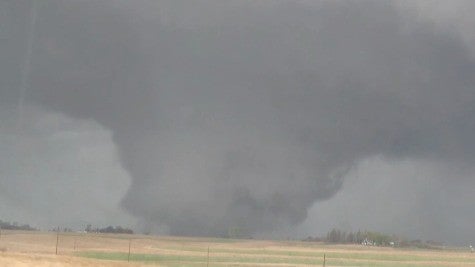
Preliminary damage estimates from the June 2008 Midwest flood puts agricultural damage in Iowa alone at $1.0 billion. At least another $1.0 billion in property damage has likely occurred--$762 million of that in Cedar Rapids, Iowa. The price tag is sure to grow, as many locations downstream are facing record flood heights this week. Levee overtopping is possible in at least 28 locations along the Mississippi River and its tributaries in the coming days, according to the Army Corp of Engineers. This year's flooding is one of the ten most damaging non-hurricane flood events in the U.S. since 1980, according to the list of billion dollar weather disasters maintained by the National Climatic Data Center. The damage from this year's flood will not come close to the record $26.7 billion in damage from the catastrophic 1993 flood, though.

Figure 1. Number of billion-dollar weather disasters in the U.S. since 1980. While it is possible that climate change has contributed to the increase in billion-dollar disasters since 1980, increases in population and wealth are primarily responsible. Image credit: NOAA/NCDC.
Billion dollar flooding disasters, 1980-2007
Below is a list of all billion-dollar flooding disasters not due to a hurricane or tropical storm in the U.S. between 1980 and 2008. Two damage figures are given for events prior to 2007. The first figure represents actual dollar costs at the time of the event and is not adjusted for inflation. The value in parenthesis is the costs normalized to 2007 dollars using a GNP inflation index.
Midwest flooding of 2008. At least $2 billion in damage.
Northeast Flooding June 2006. Severe flooding over portions of the northeast due to several weeks of heavy rainfall, affecting the states of NY, PA, DE, MD, NJ, and VA. Over $1.0 billion in damage/costs; at least 20 deaths reported.
Texas Flooding October-November 1998. Severe flooding in southeast Texas from 2 heavy rain events, with 10-20 inch rainfall totals; approximately $1.0 (1.1) billion damage/costs; 31 deaths.
Northern Plains Flooding April-May 1997. Severe flooding in Dakotas and Minnesota due to heavy spring snow melt; approximately $3.7 (4.1) billion damage/costs; 11 deaths.
MS and OH Valleys Flooding and Tornadoes March 1997. Tornadoes and severe flooding hit the states of AR, MO, MS, TN, IL, IN, KY, OH, and WV, with over 10 inches in 24 hours in Louisville; estimated $1.0 (1.1) billion damage/costs; 67 deaths.
West Coast Flooding December 1996-January 1997. Torrential rains (10-40 inches in 2 weeks) and snow melt produce severe flooding over portions of California, Washington, Oregon, Idaho, Nevada, and Montana; approximately $3.0 (3.4) billion damage/costs; 36 deaths.
Pacific Northwest Severe Flooding February 1996. Very heavy, persistent rains (10-30 inches) and melting snow over Oregon, Washington, Idaho, and western Montana; approximately $1.0 (1.2) billion damage/costs; 9 deaths. Special Report
Blizzard of '96 Followed by Flooding January 1996. Very heavy snowstorm (1-4 feet) over Appalachians, Mid-Atlantic, and Northeast; followed by severe flooding in parts of same area due to rain and snow melt; approximately $3.0 (3.5) billion damage/costs; 187 deaths.
Texas/Oklahoma/Louisiana/Mississippi Severe Weather and Flooding May 1995. Torrential rains, hail, and tornadoes across Texas - Oklahoma and southeast Louisiana - southern Mississippi, with Dallas and New Orleans areas (10-25 inches in 5 days) hardest hit; $5.0-$6.0 (6.5-7.1) billion damage/costs; 32 deaths.
California Flooding January-March 1995. Frequent winter storms cause 20-70 inches rainfall and periodic flooding across much of California; over $3.0 (3.6) billion damage/costs; 27 deaths.
Texas Flooding October 1994. Torrential rain (10-25 inches in 5 days) and thunderstorms cause flooding across much of southeast Texas; approximately $1.0 (1.2) billion damage/costs; 19 deaths.
Midwest Flooding Summer 1993. Severe, widespread flooding in central U.S. due to persistent heavy rains and thunderstorms; approximately $21.0 (26.7) billion damage/costs; 48 deaths.
Texas/Oklahoma/Louisiana/Arkansas Flooding May 1990. Torrential rains cause flooding along the Trinity, Red, and Arkansas Rivers in TX, OK, LA, and AR; over $1.0 (1.4) billion damage/costs; 13 deaths.
Western Storms and Flooding 1982 - Early 1983. Storms and flooding related to El Niño, especially in the states of WA, OR, CA, AZ, NV, ID, UT, and MT; approximately $1.1 (2.2) billion in damage/costs; at least 45 deaths.
Gulf States Storms and Flooding 1982 - Early 1983. Storms and flooding related to El Niño, especially in the states of TX, AR, LA, MS, AL, GA, and FL; approximately $1.1 (2.2) billion in damage/costs; at least 50 deaths.
New Orleans still vulnerable to a strong Category 2 hurricane
NOAA announced Monday that the rebuilt New Orleans levee system cannot withstand a strong Category 2 or higher hurricane without overtopping occurring. The Army Corp of Engineers has been given $7.1 billion so far to repair New Orleans' levees in the wake of the catastrophic failures experienced during Hurricane Katrina of 2005. Congress is considering giving another $5.7 billion for the effort. While the levees may get overtopped in a strong Category 2 hurricane, they should be more resistant to catastrophic breaches such as occurred in Katrina, when several flood walls completely failed. The Army Corps says that they have fixed the levees with better support so that water won't be able to scour out the base, and put better clay in them to keep them from dissolving.
Tropics
It's quiet in the tropics. There are no threat areas to discuss, and none of the models are forecasting tropical storm formation in the next seven days.
Jeff Masters
I am trying to get back from a riverfront home that I am trying to keep the pumps running at. This was a well traveled road.
Where did Alexandria go? (
nauvoo)
From the bridge at the IA/MO state line it does not look like much is left.
Water over the sandbags! (
nauvoo)
They could not keep up with the rising waters at this historic train station on the river front.4 more feet of water are forecast.
Page: 1 | 2 | 3 | 4 | 5 | 6 | 7 | 8 | 9 | 10 | 11 | 12 | 13 | 14 | 15 | 16 | 17 | 18 | 19 | 20 | 21 — Blog Index
NOAA announced Monday that the rebuilt New Orleans levee system cannot withstand a strong Category 2 or higher hurricane without overtopping occurring
I think my post got lost but thanks Dr. M for the information; while the "Army" gets the money, I suspect that lots of private contractors are in on the "funds" so to speak...If there is another significant failure from a mere Cat 2, after these expenditures, they should all be held personally liable........
Corps to hold meeting tonight in Metairie
by The Times-Picayune
Tuesday June 17, 2008, 7:02 AM
The U.S. Army Corps of Engineers will host a public meeting today at Gates of Prayer, 4000 West Esplanade Ave., Metairie.
The meeting will begin with an open house at 6 p.m., during which corps officials will be on hand to answer questions from the public. A presentation about the area's portion of the hurricane system begins at 7 p.m., followed by a discussion period.
The LaBranche Wetlands Levee, West Return Floodwall and Lakefront Levees will be discussed involving Individual Environmental Reports 1, 2, and 3, as well as the potential areas from which borrow materials may be obtained.
Corps Of Engineers Link
From: New Orleans International Airport To: 7400 Leake Ave, New Orleans, LA 70118
Driving Distance: 15.4 miles Time: 31 minutes Link
136. ShenValleyFlyFish
I'm not sure...IKE, how did you do last year?
I've got 24....there are others with more. My list goes back at least one year.
134. IKE 5:07 PM EDT on June 17, 2008
131. Floodman 4:02 PM CDT on June 17, 2008
So what's the record for ignore list? At this rate I figure I might break it.
How many have you got on ignore?
Kind of quiet in here right now...
Credit:Susie77
Would a direct impact from Cat-3 on Miami be more costly than to New Orleans, which only has a fraction of the population that Miami has?
Wouldn't a direct impact from a fast moving Cat-3 hurricane on New York harbor have a more costly impact and probably a larger loss of life?
I know for a certainty that a direct impact from a strong Cat-3 into Freeport, Tx. with storm surge up the Houston ship channel would be more costly to the nation than another Katrina.
Yes, we are right to focus on New Orleans and it's vulnerability, which will be tested again some day. However, there are other areas that are equally important and just as vulnerable that are getting far less attention now.
...the ITCZ is the lifeline that is helping this system survive for now
I mentioned this last night and said as it crossed 35-40w it could begin to take a natural "2-degree" corilois if it were trying to develop a low level center. The ITCZ is what's been mostly feeding it convection in the last day or so anyway. However, with a northwards movement away from the ITCZ into the dry air environment it can not survive. It's only possibility to make it is to move westwards and remain somewhat attached to the ITCZ for convection. Otherwise, it's *pooooof* city, soon!
I see I've got some catching up to do. However that only covers about 1/2 of last season and I stripped some of those off. Figured they'd turn up under new handles this season.
I've been holding off comment in hopes that someone else would remark on the irony of the meeting site. Guess they are telling folks ahead of time what to expect and who to count on.
155. IKE
I see I've got some catching up to do. However that only covers about 1/2 of last season and I stripped some of those off. Figured they'd turn up under new handles this season.
Same here....
Link
““It blows my mind.””
““That should be criminal,”” Taffaro continues.
What he's talking about was witnessed by a St. Bernard Parish resident who didn't want to be identified, but did have sharp criticism of the work done by a contractor hired by the U.S. Army Corps of Engineers.
““It's like putting a Band-Aid on the hole of a gas tank of an airplane,”” the resident said.
Instead of an airplane, it's a floodwall, and instead of a Band-Aid, the witness says two years ago, he saw the contractor filling the expansion joint or opening between the floodwalls with newspaper.
““The whole length of the wall was stuffed with newspaper.””
And when he confronted the contractor, the contractor blamed Washington for the substandard work.
““He basically told me when Congress sent down the money, it would be repaired the proper way.””
But during a recent trip to the area, two years later, it was apparent that didn't happen. Much of the newspaper had deteriorated or been eaten by bugs, but some still remained. In fact WWL cameras even captured the date May 21, 2006, on a page of the Parade magazine from the Times-Picayune.
Eyewitness News asked local engineer Subhash Kulkarni to investigate the findings at the floodwall.
““They should have done a better job than what you see here.””
Kulkarni is a member of the American Society of Civil Engineers. The ASCE named him outstanding civil engineer in Louisiana back in 2003.
““I cannot even comprehend that somebody would stuff some newspaper in there.””
Engineers tell Eyewitness News an expansion joint has three lines of defense. The first is an elastic strip that helps keep water out. In the middle is the most important part, a waterstop, which is in fact included in the St. Bernard floodwall. However what is missing is a rubber joint that goes in between and helps keep foreign objects out.
The witness who talked to Eyewitness News says the contractor used the newspaper in place of the rubber joint. Kulkarni says it's not a short term risk, but over time that missing rubber joint could weaken that waterstop.
““It could be very serious,”” Kulkarni said. ““It doesn't take a lot of stress to cause the failure of these floodwalls. We don't know after two or three years how the main joint will perform. This is the first line of defense.””
But the Army Corps of Engineers says it is confident the floodwall will sufficiently defend residents of St. Bernard and the Ninth Ward.
““If you look at the repairs we made to the joints, there's not really a safety issue with the joints at all,”” said Kevin Wagner with the Army Corps of Engineers.
The Corps also says it’’s satisfied with the quality of work done by its contractor. When asked by WWL if there was any shoddy work involved, Wagner said, ““I don't think so at all.””
But days before that interview, after a request by Eyewitness News , another Corps employee e-mailed the Corps’’ standards for expansion joint construction and in that e-mail, the Corps employee describes the specific materials needed as "sponge rubber" that goes next to the waterstop. That’’s the same spot where a witness saw a contractor stuffing newspaper back in 2006.
When asked if the absence of material behind the waterstop was what was called for in the contract, Corps spokesman Kevin Wagner called the project an emergency repair.
““If we would have built a new floodwall that would not have been the case. We would have the waterstop, some joint filler material in between and then we would put an elastic sealer over the top of it,”” Wagner said. ““In this case we tried to do the repairs as quick as possible to protect the water stop before the start of hurricane season.””
But according to the contract obtained by Eyewitness News, that may not be the case. The contract calls for Ercon Corporation, based in Lafayette, Louisiana, to do the almost $2 million of work to raise and repair the floodwall under the Paris Road bridge.
In the contract, WWL found at least four mentions of field molded sealants. Kulkarni says that is the sponge rubber material to fill the cavity in the expansion joint. And he says the contract shows the rubber material was contractually required to be installed.
““I would say they have not met their obligation to install the joint correctly. They haven't installed it at all,”” Kulkarni said.
Eyewitness News contacted the president of Ercon Corporation by phone and e-mail. He didn't respond to our repeated requests for a comment on this story. Further, our investigation revealed Ercon Corporation is not even licensed by the state's board for contractors. The Corps of Engineers says as long as the federal government pays for the work, it does not prevent them from hiring an unlicensed Louisiana company.
““If you're telling me this is an out of town contractor who drives back to wherever they're from and puts their head on the pillow at night, does it really matter to them that this particular part of the project fails?”” St. Bernard president Craig Taffaro asks.
Taffaro calls the response from the Corps and Contractor unacceptable.
““Would they let a contractor put Play-Doh in the place of mortar when they put bricks on their house? No, I don't think so,”” Taffaro said.
He says while newspaper doesn't define the entire levee system, it does have him concerned about the oversight of all work being done in southeast Louisiana.
““It's an indictment against the quality of work being done,”” Taffaro says. ““Let’’s hope that same standard wasn't being used in constructing the floodwall in constructing the levees.””
Thanks for the reminder. Does everyone realize this is free. Sure makes wuground a much slicker experience. Firefox is a free open code site with much better compliance to standards than IE and some nice features lacking on Safari. IMACO (in my arrogant conceited opinion)
Link
There is a series of Web pages that may be of use: The paradigm is "drill down."
If you start at: http://www.weather.gov/ahps/ you will see something like:
If you click on the map above, you will zoom in to the area served by a local National Weather Service office, e.g., Note that the color code indicates the general severity of flooding. If you click on one of the color-coded locations, you will get a "hydrograph:" The hydrograph shows how the river varies over time. The past is on the left and the future is on the right. The blue line on the left shows observations of what has occurred. The green portion on the right shows forecast conditions.
Frank Richards
....uuuummm, "drill down" ??? That's not exactly the kind of response I was looking for. And, I knew where this was already. What I am interested in is where these "28" areas of risk are. IMO they should be clearly pointed out on a map with links that describe the risk. Maybe I'm being a tad overboard here; but, it's in Doc's header and I've read it on another news site as well - yet nothing shows where these areas are or what the risk is. Suppose for a moment that you had friends, relatives or know someone in one of these risk areas - one could call and check on them, offer help, etc. It's just "poor communicative" effort in my opinion. Not very informative and not overly helpful. UGH!
Mississippi River breaks through Illinois levee
GULFPORT, Ill. - The rising Mississippi River broke through a levee Tuesday, forcing authorities to rescue about a half-dozen people by helicopter, boat and four-wheeler as floodwaters moved south into Illinois and Missouri. But even as the water jeopardized scores of additional homes and businesses, officials said the damage could have been worse if the federal government had not taken steps to clear flood-prone land after historic floods in 1993.
On Tuesday, the flooding halted car travel over two bridges linking Illinois and Iowa and threatened to cover areas near tiny Gulfport with 10 feet of water.
Thank you for the Firefox 3 update it is great!
oh needs DSL with the new firefoxs this is all most like DSL huh?
How's everybody tonight? Any feathers ruffled? Lol.
Disgusted that it is raining 40 miles away and not a drop in sight. Water rationing has begun in mine & surrounding cities. The poor folks in Iowa have way more than they can handle.
Still blob hunting I see.
(then again, i've been accused of being "closed-minded"! LOL)
http://cimss.ssec.wisc.edu/tropic2/real-time/dlm/atlantic/dlm1.GIF
its faster =) WU was slower for some reason and now its fast =)
I see the tropical wave seems to be firing some convection =P lol it wants to remain interesting =D
Sheri
Frank Richards deserves a raise. That's a fine job of bureaucratic obsfucation.
I'm with you. Where did the # 28 come from and where the heck are they?
too bad we can ues the Modify Comment in the new firefoxs 3
I can...
too bad we can ues the Modify Comment in the new firefoxs 3
I can too
Viewing: 151 - 201
Page: 1 | 2 | 3 | 4 | 5 | 6 | 7 | 8 | 9 | 10 | 11 | 12 | 13 | 14 | 15 | 16 | 17 | 18 | 19 | 20 | 21 — Blog Index