Open Source Communities, What Are the Problems? Open Climate Models (3)
I want to return to the series that I started about community approaches to climate modeling. Just to help me get started I am going to repeat the last two paragraphs from the previous entry in the series. (#1 in series, #2 in series)
I managed large weather and climate modeling activities when I was at NASA. On a good day, I maintain that I managed successfully. When I was a manager I sought control, and I grimaced at some naïve ideas of community. My experience tells me that we need to investigate new ways of model development and model use. This need arises because the complexity is too large to control, and this is especially true as we extend the need to use climate models to investigate energy policy decisions and adaptation to climate change.
In the past decade we have seen the emergence of community approaches to complex problem solving. Within these communities we see the convergence of creativity and the emergence of solution paths. We see self-organizing and self-correcting processes evolve. Counter intuitively, perhaps, we see not anarchy, but the emergence of governance in these open communities. The next entry in the series will focus more on describing open communities.
Open Communities, Open Innovation: The past 10 years have seen the emergence of open communities that do things from build software, to collecting information about birds, to building large knowledge bases. An example that often comes to mind is Wikipedia. Wikipedia represents an immense knowledge base. Experts (and not) can write and modify entries. And while anyone can modify the entries that does not mean that there is complete anarchy. There are rules of governance, that in this case translates to editorial standards that assure some level of evaluation of information and affirms some level of accuracy. Such a standard is exemplified in, for example, Wikipedia’s policy of no original research. Wikipedia is even evolving as a place to provide documentation about Earth system modeling infrastructure.
Open communities also include efforts to build software. One of the most famous examples is the development of the computer operating system Linux. Another example of software development is the Apache Foundation. The Apache Foundation represents many software projects, and from their website is “not simply a group of projects sharing a server, but rather a community of developers and users.” “The Apache projects are defined by collaborative consensus based processes, an open, pragmatic software license and a desire to create high quality software that leads the way in its field.” If you explore these websites the community is open, but there are rules and values that are shared by those working in the community. There is a process by which individuals contributions migrate into the products that are branded and provided by the community. That is, there is a governance model.
The two previous paragraphs are examples of two types of community approaches, and there are other types of communities such as Project Budburst and the Encyclopedia of Life. There are grassroots communities such as the atmospheric chemistry community GEOS-CHEM. Some communities have been remarkably successful. They inspire and harvest creative solutions to complex problems. They provide a culture in which ideas and solutions converge and emerge; they contain the attributes of being self-organizing and self-correcting. And in many cases people contribute to these communities without what is traditional compensation; that is, they do it for free.
What is the motivation to participate in such a community for free? And are such communities sustainable and reliable? The participation without being paid is contrary to the intuition of traditional managers. There are people who study the motivation and governance of communities, for example, Sonali Shah and Matthias Stürmer. Some who are motivated by contributing to knowledge, and others by making their mark in some large effort. Others are motivated because they need something that is otherwise not available, and the existing efforts in the community provide the foundation for filling that need. In this case the participation in the community lets them do something that is not otherwise possible. A reason that I often find amongst scientists is the feeling that there are certain tools that should be free, and therefore, they are willing to spend the time to make the tool free, with the expectation that there are others who will also contribute their efforts. Within the federal research community, there is often the value that if tax dollars paid for the generation of data or knowledge, then that data or knowledge should be as widely available as possibly (see National Institutes of Health Public Access Policy). In the same vein, sponsors of research are constantly advocating more community interaction in order to enhance capabilities and, potentially, reduce unneeded duplication of efforts.
Community-based approaches and open access to information are concepts that have been around for far longer than what we might call the internet age. Paul Edwards in his book A Vast Machine talks about the emergence of the need to share information in the study of weather because of the common need to share observations in order for weather forecasts to be useful. Throughout my career at NASA, we would occasionally be asked to do model experiments of what would happen if we (the U.S.) or some other country decided to start charging for all or part of weather data. Sometimes the studies were motivated by – if “our” weather data is “so” important, then others should be paying for it. Well, it turns out everyone’s data is important; for forecasts to be good in the U.S. we need to know what is happening in Canada and out in the Pacific Ocean. So we benefit from open access to the basic information about the Earth’s environment.
I have been exploring the need for open community approaches to addressing climate change in general. The subject of the current set of articles is climate models, and whether or not we could have climate models that are not only accessible, but that could be correctly configured and run by a wide-range of what might be non-expert customers of climate information. To note once again, there are numerous climate models that are accessible, and which can be altered and run by the user, for example, the Community Earth System Model. These models require highly specialized expertise and computational resources.
Sticking with just the focus on climate models, arguably the open source software communities named above provide what might be called an existence criterion. That is, there is the existence of a solution. With this existence, there seem two questions to motivate how to go forward.
1) What are the important elements of successful open source development communities that would be required in an open innovation climate modeling community?
2) What are the similarities and differences of climate modeling to these communities that might help to advance or prohibit the development of a broader, more inclusive, climate modeling activity? Or stated in another way: is climate modeling in some way unique?
I have already hinted at one of the elements of successful software communities - there must exist, namely, governance. When I first started discussing open communities with my manager colleagues in national laboratories, their first response was that climate models could not be developed, evaluated, and implemented in an uncontrolled, anarchist environment. In case you have forgotten, I started this blog with the statement that I was a government manager, and I felt that control was important to me to deliver evaluated systems on time and within budget. It is important to realize, to inculcate, that open communities are not ungoverned, and if they are functional, they are not anarchist. So the development of governance approaches is an essential element; one that will be addressed more fully in future entries.
Approaching the second question posed above, how is climate modeling different from the software developed in the successful software communities mentioned above? One difference is the need to express complex phenomena with quantitative, scientific expressions. In an earlier entry I posed you could image a climate model by posing the following questions: If you were to look around at the clouds, sky, the plants, the people, the landscape, the streams, and ask the question – how do I represent these things as numbers? How do I represent how these things will change? How do I represent how these things interact with each other?
If you imagine developing the operating system for a computer, there are certain well defined tasks that need to be done, and it is possible to check with some precision whether or not you have accomplished the task. In climate modeling such precise definition is not possible, which means there is always an element of scientific judgment that is needed in the evaluation of whether or not the development of a component or sub-component has been successful. And, there is no reason to expect that combining successful sub-components and components yields a functioning climate model. Some would state that building, evaluating and deploying a successful climate model is not just a matter of building software, but it is a combined science-software activity. There is concern that community approaches that have been successful for task-oriented software projects cannot adequately incorporate the scientific integrity needed for proper climate model evaluation. This need to maintain science-based evaluation is perhaps the most formidable hurdle that must be addressed, not only, towards the ambitious goal I outline of configurable models for use by non-experts, but even for broader inclusion of the expert community.
I will end this entry here. Note a couple of new things below.
r
Another Big Flood
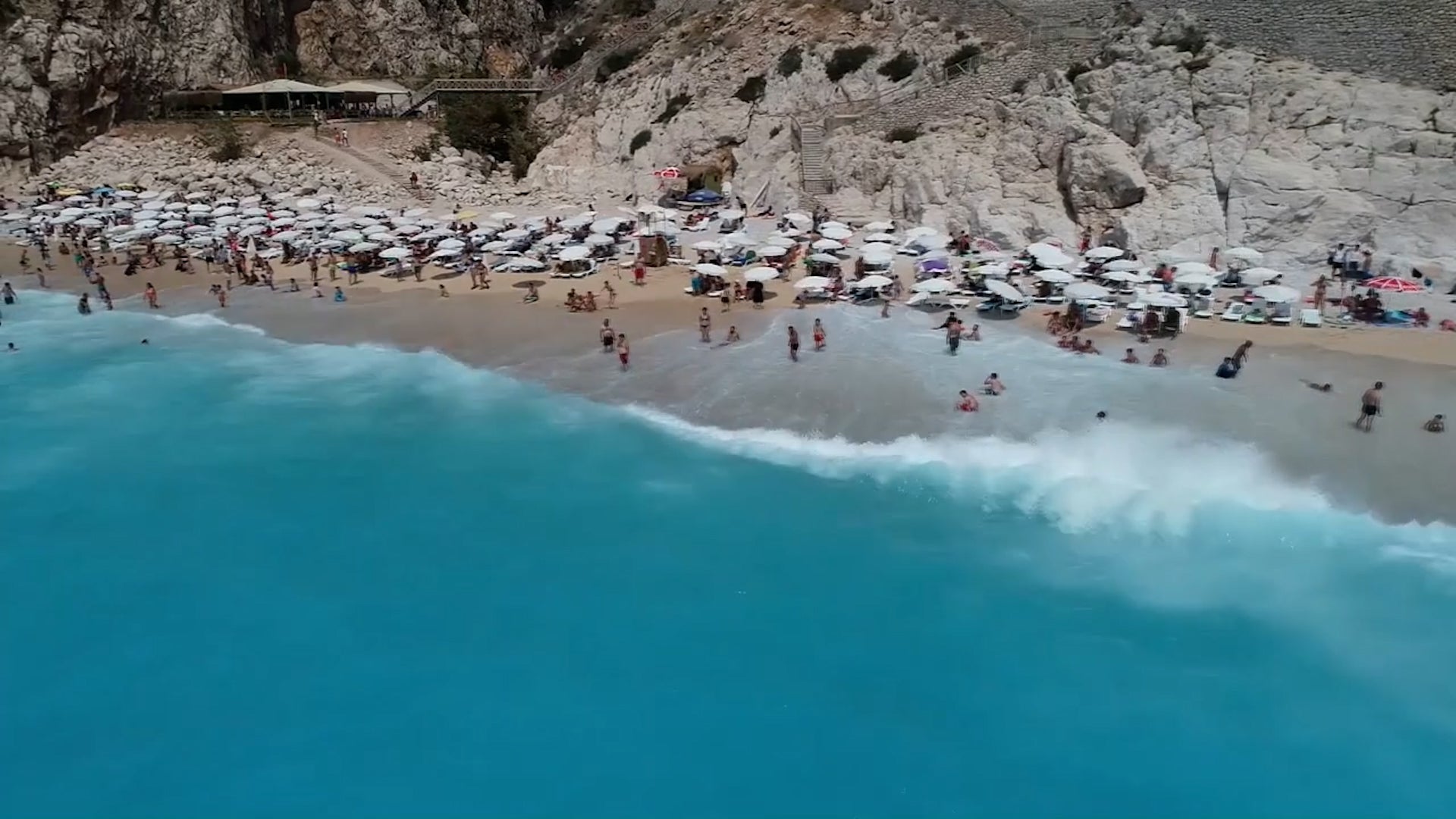
There have been a lot of big floods in the past year. Now we have the record flood in Australia (a great summary in the Boston Globe). I argued that the 2010 flood in Pakistan brought together people, geography, societal assets, wealth, weather and climate in a way that it was a case study in a climate disaster. So does the Australian flood, but it is, perhaps, on the opposite side of the scale.

Figure 1. From the Australian flood. Taken from the excellent summary at the Boston Globe.
Pakistani Flood Relief Links
Doctors Without Borders
The International Red Cross
MERLIN medical relief charity
U.S. State Department Recommended Charities
The mobile giving service mGive allows one to text the word "SWAT" to 50555. The text will result in a $10 donation to the UN Refugee Agency (UNHCR) Pakistan Flood Relief Effort.
Portlight Disaster Relief at Wunderground.com
An impressive list of organizations
Reader Comments
Page: 1 | 2 | 3 | 4 | 5 — Blog Index
Now as a stock chart we'd note that the trend is definitely up, but as you can see the average seems to really have moved up by a couple of tenths since the mid eighties or about a tenth degree per decade or
about a rate of increase of one degree per century.. Maybe my eyes deceive me. Maybe the chart is false. It's from Spencer's site and I don't know what UAH means.
Those two el nino events are called breakouts in the stock chartists vernacular, but this is no Apple or Google and the breakouts weren't sustained.
Can a wallaby swim
Do you really believe the crap that you post? Tell me, Michael, as a percentage of world GDP, do we spend more on food today than 20 years ago, 40 years ago? Do you know? Do you care? Why don't you post a photo of a food riot in Bangladesh? That should be adequate proof that the world is about to implode from lack of food production. Give us a whole gallery of polar bears, wallabies and starving peoples and an address for where we should send our checks.
Cold records don't really matter. Now if you have a picture of a robin freezing to death, that would be a different story. Do you have a picture? A hospital emergency room full of kids with rheumatic fever would be good , too. Got one? How about people just freezing in the streets? Try Googling Siberia. Amga is a little cool this time of year. Amga
Which basically means that the average temperature in 2010 was above that of the average of the historical record, which encompasses roughly 1850-present. As long as temperatures are at this level, record highs will outnumber record lows, even if the temperature trend declines. For records lows to outnumber record highs, the temperature will have to fall near or below the historical (ca. 1850-present) average.
Here you go, look at these readings and count how many occurred in the 1930s, the hottest decade. I've seen a graph of these high temperature records, but was not able to find it.
Stae by state high temperature records
OK. So this will be a bit of a drive-by and probably nit-picky but...whatever.
I can easily find sites where the data you posted comes from, but was curious to see the specific data concerning where the "99% of Americas[sic]...glaciers..." quote comes from. It seems to come from a book--"Glaciers in Alaska" written in 2008 by Bruce Molina. That makes me wonder if Bruce Molina wasn't misquoted and it should have referred to "99% of Alaska's glaciers" as this is how it is quoted in the MSN article about the book. It seems like a good possibility since the book was about glaciers in Alaska.
Anyway, I would be curious to see the data behind the 99% figure, even if it is just Alaska. I would expect that most glaciers are retreating, but 99% seems like a high figure. I can't find the data online, and I'm not buying the book.
Also curious about the sample size. This claims that there are 100,000 glaciers in Alaska, of which only 616 which are named.
A last, minor point. In the MSN article about Molino's book that I'm posting, it mentions the following near the end:
Maybe MSN got it wrong, but a couple of things bother me. The 95% figure seems low if 99% of all of them are retreating. Also if all of the glaciers that have advanced are at higher elevations, shouldn't the figure of glaciers retreating at lower elevations be 100%?
LOL. Maybe I'm just tired. Anyway, if you're curious and you find a link to specific data concerning the 99% figure, I'd be interested in seeing it.
A drive-by, like I said earlier, as I'm out for the night. Good night to all.
You guys should take a few minutes to read this article, China and the Barbarians. Until now, I just believed that Hansen was wrong headed. Now I know better. The article is the ranting of a mad man. He is off his rocker guys, an absolute loon.
I believe he might be schizophrenic. Clearly he has illusions of grandeur in that he actually believes the Chinese will listen to him because he has such knowledge and that they must because they are the only ones that can save the world.
He even takes a moment to discuss his climbing of a mountain as an aside as though the reader really gives a crap about that.
Perhaps he is just naive and just doesn't understand human instinct and economics. Maybe I should give him the benefit of the doubt.
No, I think not. He suffers from the same type of mental disorder as Hugo Chavez and Adolph Hitler. It's called narcissism. Thank God this will be over in another two years.
Going down instead of up, is this the right direction in January,Martini? See how correct Hansen is and how uninformed you are?
Michael, you really don't get it. I'm all for clean energy. Everyone is. Why wouldn't they be?
Here's the rub, it has to be more efficient than conventional or nuclear or it just won't replace it. Over time it will be. In the meantime China will still build one new coal burning electric plant PER WEEK.
Maybe you believe in fairy tales, Michael. Maybe you believe that the car companies have always supported big oil by building gas guzzlers.
I don't believe in fairy tales. I believe the car companies did what they did thinking it would make them more money just as the Chinese will do nothing to reduce their competitive advantages.
So quit being naive and pushing foolish alternatives. A move to natural gas burning electric plants and electric cars is doable, profitable, efficient and will reduce the emissions you are so concerned about. Start preaching practical half solutions rather than impossible solutions.
You think it was the same from 1850 to 1940?
You think all of the glaciers on the planet got the tweet that the LIA was over and went back to "normal" in 1851?
Or, could it be that these glaciers, and many others, are just slowly working towards some equilibrium state and have simply been losing since the end of the LIA and nothing man can or cannot do, or already did, is going to change that?
Ya no Cyclone, it is a puzzlement. Average sea surface temperatures worldwide are about 1/2 degree colder this year than last and we are colder, in the oceans, than 2008 also. So, how come so much heat is concentrated in the seas around Greenland and Hudson Bay? Beats me.
But, if it was due to global warming, how would you explain how cold the rest of the world is? Take a shot at it Cyclone.
What's absurd about that question? And, that's not in the past 100 years, genius.
Is the attitude because you don't like the questions I asked? It's logic's fault, not mine. Sorry. Curse logic if it makes you feel better.
Merited? Have you even ever looked at a historical temperature reconstruction for the last 1000 years?
I don't like the idea of government interference in the economy.
However, I do have a good idea about a solution to energy independence that would also help reduce pollution and also reduce carbon emissions.
Electric cars are a good idea. Here's why.
The infrastructure is in place that being major electric plants. Although some additional would be required, most charging of batteries would be done at night when plant capacity is available.
A generating plant using NG is more efficient at production of energy than millions of cars having their own generating plant whether by gasoline or NG.
We, the USA, have an abundance of NG. Therefore we move toward energy independence. Because the production of electricity for cars by plants is more efficient than each car burning carbon, we burn less carbon overall.
The government doesn't need to encourage gas production, the supply is already so great that NG is very cheap. What they could do would be to coordinate the electric utilities with the manufacturers of cars and batteries with some sort of tax credit scheme. I don't like the idea, but I suppose I could put up with it if it made sense.
I would prefer to have as little government involvement as possible because they always screw things up with stupidity and criminality.
Ouch!
Can you give us conjecture, next?
But, reality is that trees (part of the data in that plot) aren't very good thermometers...
Viewing: 1 - 51
Page: 1 | 2 | 3 | 4 | 5 — Blog Index